
Most australian businesses underestimate just how much website structure shapes success online. A well-planned website does more than connect pages—it directly impacts how people explore, find information, and make decisions. Studies reveal that websites with clear structures can increase conversion rates by up to 200 percent. Understanding common myths and proven models helps australian entrepreneurs build digital experiences that guide customers effortlessly while driving results.
Table of Contents
- Defining Website Structure And Common Myths
- FAQs About Website Structure
- Types Of Website Structure For Businesses
- FAQs About Website Structures
- How Structure Impacts SEO And User Experience
- FAQs About SEO And Website Structure
- Essential Elements For Effective Site Architecture
- FAQs About Site Architecture
- Risks Of Poor Structure And Common Pitfalls
- FAQs About Website Structure Risks
Key Takeaways
| Point | Details |
|---|---|
| Importance of Website Structure | A well-planned website structure enhances user experience, engagement, and conversion rates. |
| SEO Benefits | Logical website architecture improves search engine indexing and can lead to higher search rankings. |
| Types of Structures | Consider different models like hierarchical, sequential, matrix, and database-driven based on business needs. |
| Risks of Poor Structure | Complicated navigation and fragmented content can lead to increased bounce rates and lost customer conversions. |
Defining Website Structure and Common Myths
Website structure represents the strategic organisation and arrangement of digital content that determines how information flows and users navigate through a website. At its core, website architecture involves the structural design of shared digital environments to enhance usability and findability for visitors.
Contrary to common misconceptions, website structure is not simply about creating pages and linking them randomly. Effective website architecture requires deliberate planning that considers user experience, information hierarchy, and strategic content placement. Net Branding professionals understand that a well-designed website structure can significantly impact user engagement, conversion rates, and overall business performance.
Traditionally, website structures are categorised into several fundamental models: hierarchical, sequential, and flat. Hierarchical structures prioritise logical categorisation, allowing users to navigate from broad categories to specific subcategories. Sequential structures guide users through a predetermined path, ideal for processes requiring step-by-step progression. Flat structures offer direct access to content with minimal navigation layers, suitable for smaller websites with limited information.
Pro Tip: Website Mapping Strategy: Before developing your website, create a detailed sitemap that visualises your content hierarchy, ensuring intuitive navigation and logical information flow for your target audience.
FAQs About Website Structure
Why does website structure matter for SEO?
Website structure helps search engines understand and index your content more effectively, improving your website’s search ranking potential.How often should I review my website structure?
Recommend reviewing your website structure annually or whenever your business offerings or user needs significantly change.Can a poor website structure hurt my business?
Yes, a confusing website structure can increase bounce rates, reduce user engagement, and potentially cost you valuable customer conversions.
Types of Website Structure for Businesses
Different website structures play a critical role in determining how effectively businesses communicate their digital offerings. Net Branding professionals recognise that selecting the appropriate website structure is not merely a technical decision but a strategic business choice that directly influences user experience, engagement, and ultimately, conversion rates.
Businesses typically employ four primary website structure models: hierarchical, sequential, matrix, and database-driven. Hierarchical structures remain the most common, organising content from general categories to specific subcategories, similar to a traditional organisational chart. This model works exceptionally well for businesses with complex product ranges or service offerings that require detailed navigation. Sequential structures are particularly effective for businesses with linear processes, such as e-commerce sites guiding customers through purchase stages or service providers outlining consultation steps.
For small to medium enterprises, choosing the right website structure depends on multiple factors including business type, content volume, and user interaction goals. Matrix structures offer flexibility by allowing multiple navigation paths, which can be ideal for businesses with interconnected content or services. Database-driven structures dynamically generate pages based on user interactions, providing personalised experiences that can significantly enhance user engagement and retention.
Here is a comparison of the main website structure models and their typical business applications:
| Structure Model | Best For | Navigation Style | Business Example |
|---|---|---|---|
| Hierarchical | Complex content | Multi-level categories | Large retailer |
| Sequential | Step-by-step processes | Linear, guided paths | Online checkout |
| Matrix | Interconnected topics | Multiple navigation paths | Educational portal |
| Database-driven | Personalised experiences | Dynamic content delivery | Membership websites |
Pro Tip: Structure Selection Strategy: Conduct a comprehensive user experience audit before finalising your website structure, mapping potential user journeys and ensuring your chosen design supports intuitive navigation and seamless information access.
FAQs About Website Structures
How do I know which website structure suits my business?
Analyse your content complexity, user interaction needs, and business goals to determine the most appropriate structure.Can I change my website structure later?
Yes, but it’s complex and can impact SEO, so professional guidance is recommended.Do different industries require different website structures?
Absolutely. Retail, service-based, and informational businesses often need unique structural approaches to optimise user experience.
How Structure Impacts SEO and User Experience
Website structure plays a pivotal role in determining both search engine optimisation and user engagement strategies, directly influencing how effectively businesses communicate online. Net Branding professionals understand that a strategically designed website architecture is not just about aesthetics, but a critical mechanism for improving digital performance and user satisfaction.

From an SEO perspective, website structure significantly impacts how search engines crawl, understand, and index digital content. Hierarchical navigation enables search engine algorithms to comprehend content relationships, creating clear pathways for indexing and ranking. Websites with logical, well-organised structures typically experience improved search visibility, as search engines can more efficiently map and evaluate content relevance. This means businesses with intuitive site architectures are more likely to achieve higher search rankings and attract organic traffic.
User experience represents another crucial dimension of website structure. Intuitive navigation determines how easily visitors can find information, explore products, and complete desired actions. Complex or confusing site structures can lead to increased bounce rates, reduced engagement, and potential loss of potential customers. Effective website structures anticipate user needs, creating seamless pathways that guide visitors through content with minimal cognitive effort. Small to medium enterprises must prioritise user-centric design, ensuring that their digital platforms are not just informative, but genuinely user-friendly.
Pro Tip: Navigation Clarity Check: Conduct regular user testing to validate your website’s navigation structure, asking unaffiliated individuals to complete specific tasks and provide feedback on their experience.
FAQs About SEO and Website Structure
How quickly can good website structure improve SEO?
Typically, noticeable SEO improvements can occur within 3-6 months of implementing a strategic website structure.Does website structure affect mobile search rankings?
Absolutely. Mobile-friendly, responsive structures are crucial for maintaining strong search engine rankings.Can poor website structure harm my business’s online presence?
Yes, ineffective structures can significantly reduce user engagement and search engine visibility.
Essential Elements for Effective Site Architecture
Information architecture requires strategic planning of digital content organisation that supports both user experience and technical performance. Net Branding professionals recognise that effective site architecture goes beyond simple page arrangement, serving as a critical foundation for digital communication and business success.
The fundamental elements of robust site architecture encompass multiple interconnected components. Navigation hierarchy stands as the primary structural backbone, creating logical pathways for users and search engines. Clear, consistent labelling ensures visitors can intuitively understand and traverse website content, reducing cognitive load and potential frustration. Implementing a well-designed internal linking strategy further enhances this structure, creating semantic connections between related content and distributing page authority effectively.
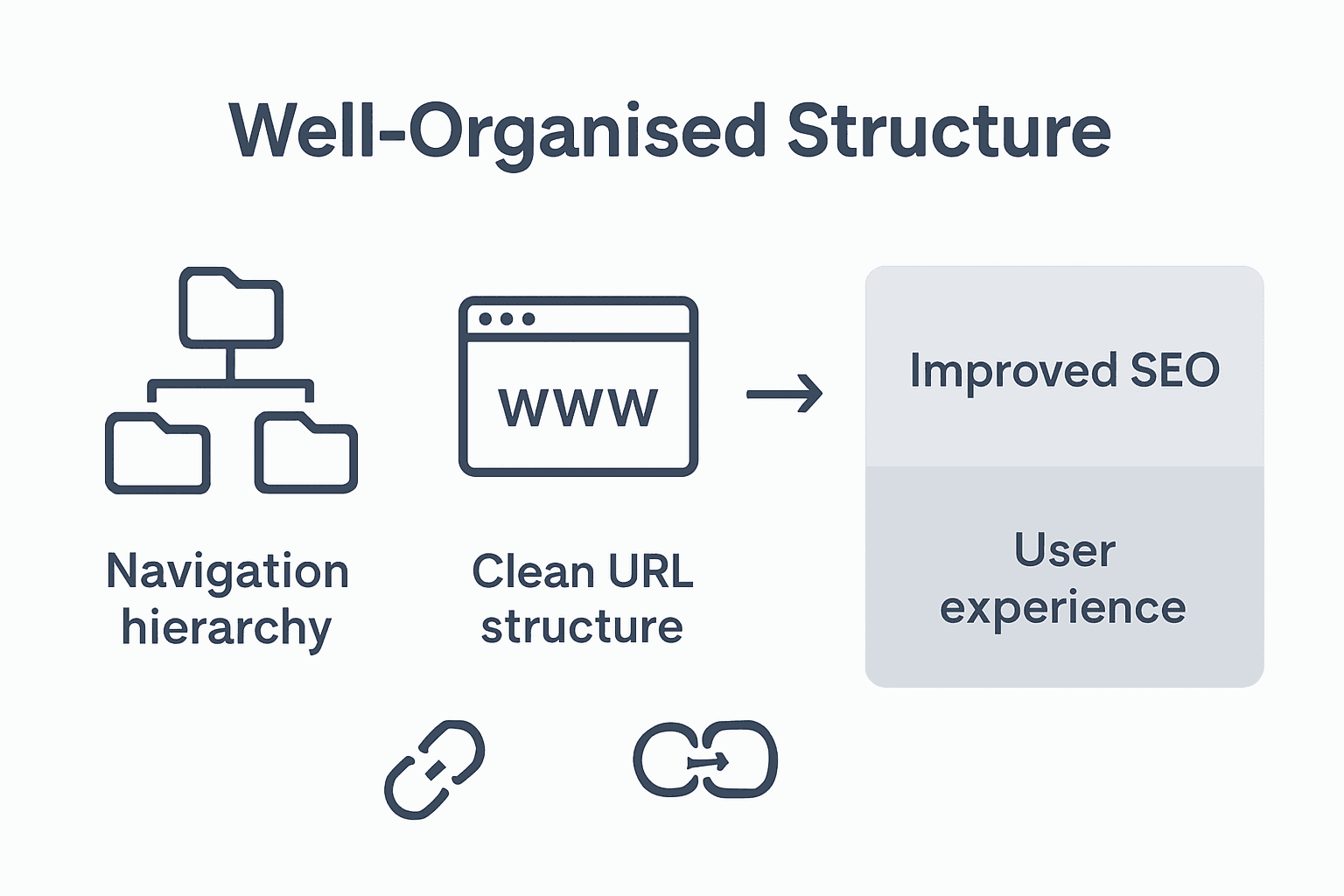
URL structure represents another crucial architectural element that directly impacts both user experience and search engine performance. Descriptive, readable URLs provide immediate context about page content, improving user understanding and search engine comprehension. Small to medium enterprises must prioritise creating clean, meaningful URL paths that reflect content hierarchy and include relevant keywords. This approach not only supports better indexing but also contributes to improved click-through rates by offering users transparent insights into page content before they even click.
Review the key elements of effective site architecture and their impact:
| Element | Purpose | Benefit for Business |
|---|---|---|
| Navigation hierarchy | Guides users through content logically | Enhances usability and retention |
| Consistent labelling | Ensures clarity in navigation | Reduces user confusion |
| Internal linking | Connects related content pages | Boosts SEO and authority sharing |
| Clean URL structure | Provides user-friendly, descriptive links | Increases trust and click rates |
Pro Tip: Architecture Audit: Periodically review your website’s structure from both user and technical perspectives, identifying potential navigation bottlenecks and opportunities for streamlining content access.
FAQs About Site Architecture
How often should I review my website’s architecture?
Recommend conducting a comprehensive review annually or whenever significant business changes occur.Can poor site architecture affect my conversion rates?
Yes, complicated navigation can significantly reduce user engagement and potential sales.Are there tools to help analyse site architecture?
Multiple web analytics and SEO tools offer insights into website structure and potential improvements.
Risks of Poor Structure and Common Pitfalls
Poor website structures create significant operational risks for businesses, potentially undermining digital performance and user engagement. Net Branding professionals recognise that architectural missteps can have cascading consequences across marketing, sales, and customer experience channels.
The most critical risks stem from complex navigation and fragmented content organisation. Deep nesting represents a primary structural hazard, where important information becomes buried beneath multiple layers, rendering content virtually inaccessible to users and search engines alike. This complexity increases cognitive load, causing visitors to feel overwhelmed and frustrated. Search engine algorithms similarly struggle with deeply nested pages, often resulting in reduced indexing and diminished search visibility. Small to medium enterprises are particularly vulnerable, as their limited digital resources cannot afford the performance penalties associated with convoluted website architectures.
Broken internal linking and inconsistent URL structures compound these challenges, creating additional navigational obstacles. Websites with fragmented link pathways disrupt user journeys, causing unexpected redirects and potential abandonment. Inconsistent URL naming conventions further exacerbate these issues, reducing both user trust and search engine comprehension. Businesses must recognise that every navigational friction point represents a potential lost opportunity for customer engagement and conversion.
Pro Tip: Structure Health Check: Conduct quarterly website audits using professional analytics tools to identify and immediately resolve navigation bottlenecks and structural inconsistencies.
FAQs About Website Structure Risks
How quickly can poor structure impact my business?
Immediate effects can be observed within weeks, including increased bounce rates and reduced search rankings.Can website structure affect my marketing performance?
Absolutely. Poor structure directly influences user experience, conversion rates, and overall digital marketing effectiveness.What are the most common structural mistakes?
Overcomplicated navigation, inconsistent URL structures, and deeply nested content are the most prevalent structural challenges.
Unlock Business Growth With Strategic Website Structure
Understanding the critical role of effective website structure is the first step towards transforming your online presence. This article highlights challenges like confusing navigation and poor SEO impacts that many businesses face. Your goals are clear: create intuitive navigation, improve search rankings, and deliver seamless user experiences that drive conversions. Terms like “hierarchical navigation” and “internal linking strategy” from the article show how deep planning is essential for success.
Ready to conquer these challenges? Explore tailored solutions in our Website Archives – ResponsiveWebsiteDesign where expert advice meets practical implementation.
Take control of your digital future with ResponsiveWebsiteDesign.co.nz. Our WordPress specialists build mobile responsive, SEO-optimised websites that grow with your business. Don’t let poor website structure hold you back. Act now and partner with professionals who understand the importance of strategic design and long-term growth. Visit our SEO Archives – ResponsiveWebsiteDesign for insights or contact us today to start your transformation.
Frequently Asked Questions
Why is website structure important for business growth?
A well-structured website enhances usability, ensuring that visitors can easily navigate and find information. This can lead to higher engagement, improved conversion rates, and ultimately, business growth.
How does website structure impact SEO?
Website structure helps search engines crawl and index content effectively, which can enhance search visibility. A logical and clear site architecture enables better ranking, attracting more organic traffic to your site.
What are the common types of website structures businesses should consider?
Businesses often use hierarchical, sequential, matrix, and database-driven structures, each serving different needs based on content complexity and user interaction goals.
How can I improve my website’s structure?
To improve your website’s structure, conduct a comprehensive user experience audit, create a detailed sitemap, and ensure consistent navigation and clear URL structures to facilitate user engagement.
Recommended
- Website Architecture Explained: Boosting SEO and UX – ResponsiveWebsiteDesign
- How to Choose Website Layouts for Business Success – ResponsiveWebsiteDesign
- 7 Essential Homepage Design Tips for Business Websites – ResponsiveWebsiteDesign
- 7 Essential Steps for a Website Redesign Checklist – ResponsiveWebsiteDesign