
Over 90 percent of users say they judge a business’s credibility by its website structure. For many Australian companies, making sense of website architecture is no longer optional. Clear navigation and smart content organization shape how potential customers view your brand, interact with your site, and ultimately decide to trust you. This guide cuts through technical jargon to reveal practical steps for building a website architecture that delivers results online.
Table of Contents
- Defining Website Architecture And Its Purpose
- Types Of Website Structure Models
- Core Elements Shaping Site Navigation
- Impact On Seo, User Experience, And Performance
- Common Mistakes And How To Avoid Them
Key Takeaways
| Point | Details |
|---|---|
| Website Architecture Is Essential | It provides a logical framework that enhances user navigation and supports search engine optimisation. |
| Regular Reviews Are Critical | Conduct annual evaluations of your website’s architecture to adjust for business changes and user needs. |
| User-Centric Design Enhances Engagement | Prioritising intuitive navigation and seamless interaction increases user satisfaction and conversion rates. |
| Avoid Complexity in Navigation | Ensure that key information is accessible within 2-3 clicks to prevent user frustration and improve retention. |
Defining Website Architecture and Its Purpose
Website architecture represents the strategic organisation and structure of digital content that determines how information is presented, accessed, and navigated on a website. At its core, website architecture is about creating a logical, intuitive framework that guides users seamlessly through digital experiences while simultaneously supporting search engine optimization (SEO) objectives.
Effective website architecture goes beyond simple page placement. Site architecture encompasses the logical arrangement of information into interconnected webpages, creating pathways that enable visitors to find desired content quickly and efficiently. This systematic approach involves carefully mapping out website hierarchies, navigation menus, and content relationships to enhance user experience and website performance.
The primary purpose of robust website architecture includes multiple critical functions. First, it provides clear navigational structures that help visitors understand where they are within a website and how to reach their desired destination. Second, it supports search engine indexing by creating logical content relationships and hierarchical structures that algorithms can easily understand. Third, it improves overall website performance by reducing user frustration and minimizing bounce rates through intuitive design.
Net Branding experts understand that website architecture directly impacts user engagement and conversion rates. By designing thoughtful, user-centric digital environments, businesses can transform their online presence from mere information repositories into dynamic, interactive platforms that effectively communicate brand messages.
Pro Tip for Website Structure: Conduct regular user experience (UX) testing to validate your website architecture, ensuring that your navigation remains intuitive and aligned with your audience’s evolving expectations.
Frequently Asked Questions
What makes good website architecture?
Good website architecture provides clear navigation, logical content hierarchy, and seamless user experience.How often should website architecture be reviewed?
Review your website architecture annually or whenever significant business changes occur.Can website architecture impact SEO?
Yes, well-structured websites with clear architecture significantly improve search engine rankings and user engagement.
Types of Website Structure Models
Website structure models are essential frameworks that define how digital content is organised, accessed, and interconnected. Four prevalent website structure models provide distinct approaches to digital information management: hierarchical, sequential, matrix, and database structures, each offering unique advantages for different website objectives.
The hierarchical structure represents the most traditional model, resembling an organisational chart with main categories branching into subcategories. This approach works exceptionally well for content-heavy websites like educational platforms or large corporate sites, where information can be neatly categorised and users can easily navigate through logical progressions. Visitors can quickly understand the website’s content ecosystem by following clear, intuitive pathways.
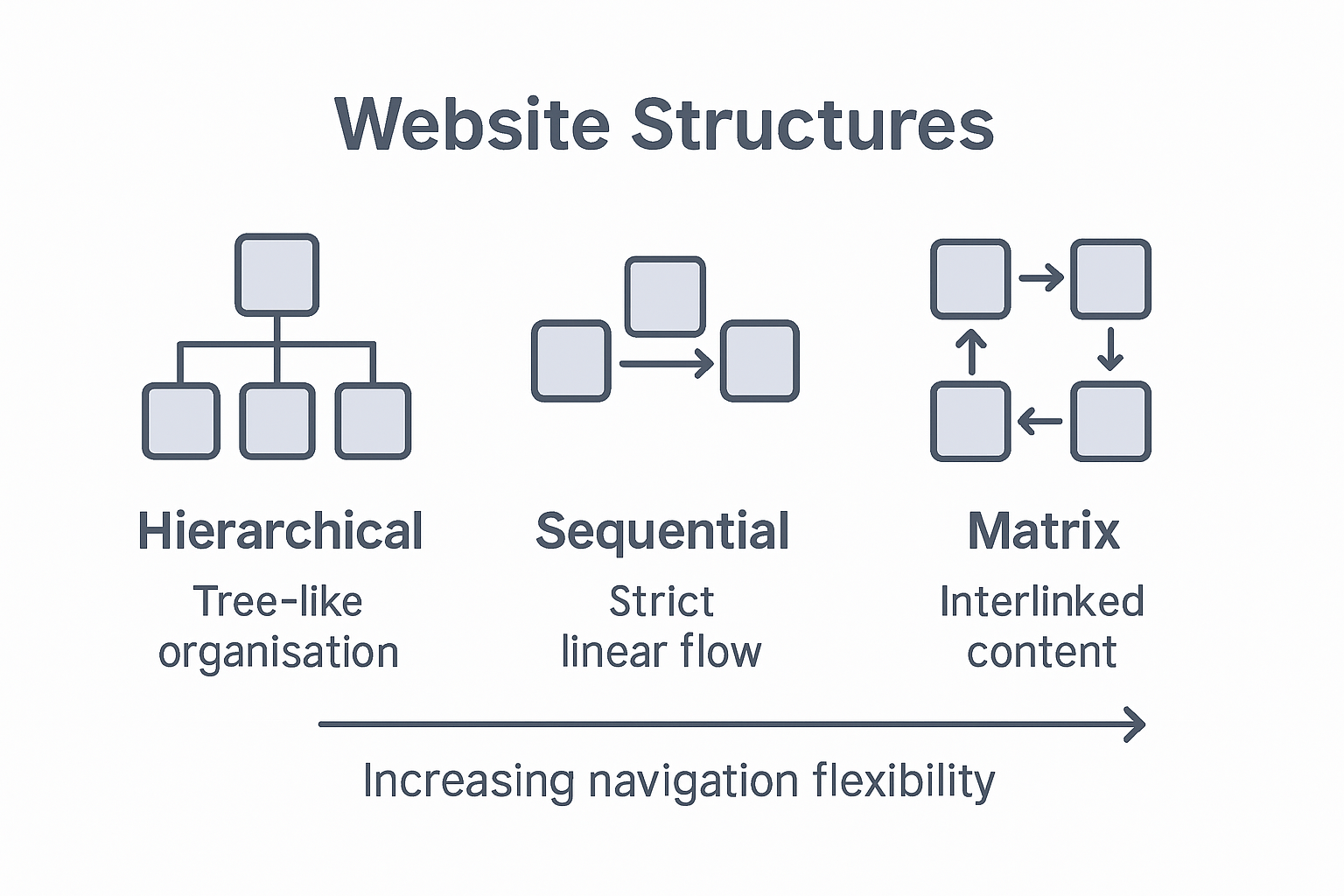
Sequential and matrix structures offer more dynamic navigation options. The sequential model guides users through content in a predetermined order, ideal for tutorial websites, online courses, or step-by-step guides where progression follows a specific learning path. Matrix structures provide maximum flexibility, allowing multiple navigation routes and interconnected content relationships. This model suits complex websites with diverse content types, enabling users to explore information through various entry points and connections.
Database-driven structures represent the most advanced approach, dynamically generating content based on user queries and interactions. These structures leverage backend technologies to create personalised user experiences, adapting content presentation in real-time. Net Branding professionals recognise that choosing the right website structure directly impacts user engagement, search engine performance, and overall digital communication effectiveness.
Pro Tip for Selecting Structure: Analyse your target audience’s browsing behaviour and content consumption patterns before selecting a website structure model, ensuring optimal user experience and information accessibility.
Here’s a comparison of the four primary website structure models and where each excels:
| Structure Model | Best Suited For | Strengths | Potential Limitations |
|---|---|---|---|
| Hierarchical | Large info-rich sites | Clear organisation, easy scale | Can become rigid or deep |
| Sequential | Tutorials or step-by-steps | Guides users linearly | Limited navigational choice |
| Matrix | Complex, highly interlinked sites | Flexible user pathways | May overwhelm with choices |
| Database-driven | Dynamic, content-rich platforms | Personalised, scalable content | Requires advanced development |
Frequently Asked Questions
Which website structure is best for small businesses?
Hierarchical or sequential structures often work best for small business websites, providing clear and straightforward navigation.How do website structures impact SEO?
Well-organised website structures help search engines understand and index content more efficiently, potentially improving search rankings.Can website structures be combined?
Yes, many modern websites use hybrid approaches, blending elements from different structure models to create unique user experiences.
Core Elements Shaping Site Navigation
Site navigation forms the critical infrastructure that enables users to explore and interact with digital content effectively. Effective site navigation is fundamentally shaped by the organisation of information, interconnectivity between webpages, and strategic menu structuring, creating intuitive pathways that guide visitors seamlessly through a website’s digital landscape.

The primary core elements of site navigation include menu structure, information hierarchy, and user interaction design. Menu structures typically encompass horizontal top menus, vertical sidebar navigation, dropdown selections, and footer links. Each navigation element must communicate clear purpose, maintain visual consistency, and provide immediate context about the website’s content ecosystem. Successful navigation design anticipates user expectations, reducing cognitive load and enabling rapid information discovery.
Information hierarchy plays a pivotal role in navigation effectiveness. Websites must strategically categorise content, ensuring that complex information is presented in digestible, logical sequences. This involves creating meaningful category labels, implementing clear visual indicators of current location, and designing intuitive pathways that allow users to understand their position within the broader website structure. Net Branding professionals understand that navigation is not merely about moving between pages but creating a comprehensive user journey that feels natural and purposeful.
Modern website navigation also incorporates responsive design principles, ensuring seamless functionality across multiple devices. Mobile-friendly navigation requires compact, touch-friendly menu designs that adapt to different screen sizes while maintaining clarity and accessibility. Advanced navigation systems now integrate search functionality, breadcrumb trails, and contextual linking to enhance user exploration and reduce friction in content discovery.
Pro Tip for Navigation Design: Conduct user testing and analyse website analytics to continuously refine your navigation structure, identifying and eliminating potential user experience barriers.
The following table summarises core navigation components and their business benefits:
| Navigation Element | Role in User Experience | Key Business Benefit |
|---|---|---|
| Main Menus | Organises primary navigation | Enables fast content access |
| Dropdown Menus | Reveals subcategories | Improves content discoverability |
| Internal Search | Helps users locate specific info | Reduces bounce rates |
| Breadcrumb Trails | Shows user’s current position | Supports easy backtracking |
Frequently Asked Questions
What makes a good website navigation?
Good website navigation is intuitive, consistent, and provides clear pathways for users to find information quickly.How important is mobile navigation?
Mobile navigation is crucial, as over 60% of web traffic now comes from mobile devices.Can navigation impact website performance?
Yes, well-designed navigation can significantly reduce bounce rates and improve overall user engagement.
Impact on SEO, User Experience, and Performance
Website architecture is a powerful determinant of digital success, with profound implications for search engine optimization, user engagement, and overall website performance. A well-structured website architecture enhances SEO by facilitating efficient crawling and indexing by search engines, creating a robust digital foundation that directly influences online visibility and user interaction.
From an SEO perspective, website architecture serves as a critical signal to search engine algorithms. Logical site structures with clear hierarchical relationships and intuitive navigation pathways enable search engines to understand content relationships more effectively. This comprehension translates into improved indexing, potentially boosting search rankings and organic visibility. Strategic internal linking, consistent URL structures, and meaningful content categorisation become powerful tools for communicating website relevance and authority to search algorithms.
User experience represents another crucial dimension impacted by website architecture. Net Branding professionals recognise that intuitive navigation, rapid content discovery, and seamless interactions are fundamental to maintaining visitor engagement. A well-designed architecture reduces cognitive load, allowing users to navigate complex websites effortlessly. By minimising clicks required to access information, creating clear visual hierarchies, and providing predictable interaction patterns, websites can significantly enhance user satisfaction and reduce bounce rates.
Performance considerations are equally critical in modern website design. Efficient website architectures support faster page loading times, improved mobile responsiveness, and optimised resource allocation. By streamlining content delivery, implementing efficient caching mechanisms, and designing lean, purposeful content structures, websites can achieve superior performance metrics. This directly influences user retention, conversion rates, and overall digital effectiveness.
Pro Tip for Holistic Website Design: Regularly audit your website architecture using comprehensive analytics tools, identifying potential bottlenecks in user experience and search engine performance.
Frequently Asked Questions
How often should website architecture be reviewed?
Recommend reviewing website architecture annually or whenever significant business changes occur.Can poor website architecture harm my business?
Yes, ineffective architecture can lead to poor user experience, reduced search rankings, and lower conversion rates.Is mobile responsiveness part of website architecture?
Absolutely, mobile responsiveness is a critical component of modern website architecture design.
Common Mistakes and How to Avoid Them
Website architecture is a delicate ecosystem where seemingly minor design decisions can have significant consequences. Common pitfalls in website architecture often stem from complex navigation structures that confuse users and search engines, creating barriers to effective digital communication and user engagement.
One prevalent mistake is developing overly complicated navigation hierarchies that overwhelm visitors. Net Branding professionals recognise that users prefer intuitive, streamlined pathways to information. Deep, multi-layered menu structures force users to click excessively, increasing cognitive load and potential frustration. Websites should aim for a flat, logical structure where critical content is accessible within two to three clicks from the homepage, ensuring smooth user journeys and maintaining engagement momentum.
Search engine optimization represents another critical area where architectural mistakes can significantly impact digital performance. Deep hierarchies can substantially hinder search engine crawling and indexing capabilities, potentially reducing organic visibility. Websites must strategically design URL structures, implement consistent internal linking, and create clear content relationships. This involves avoiding orphaned pages, ensuring comprehensive internal linking, and maintaining a logical, predictable site map that search algorithms can easily interpret and rank.
Responsive design implementation also presents common architectural challenges. Many organisations fail to consider mobile user experiences when designing website structures, creating disjointed experiences across different devices. Effective modern websites must incorporate flexible, adaptive navigation systems that seamlessly transform across screen sizes, maintaining functionality and visual consistency. This requires thoughtful responsive design strategies that prioritise touch-friendly interfaces, simplified menus, and performance optimization.
Pro Tip for Website Architecture: Conduct quarterly architectural audits using analytics and user feedback, systematically identifying and addressing navigation complexity and performance bottlenecks.
Frequently Asked Questions
How complex should website navigation be?
Navigation should be simple, with key information accessible within 2-3 clicks.What impacts website architecture most?
User experience, search engine requirements, and content organization significantly influence website architecture.Can website architecture affect conversion rates?
Absolutely, clear and intuitive website architecture directly impacts user engagement and conversion potential.
Elevate Your Website Architecture for Better SEO and User Experience
Understanding the critical role of website architecture is essential for any business aiming to boost online visibility and customer engagement. This article highlights common challenges such as complicated navigation, poor content organisation, and missed SEO opportunities that can hinder your website’s performance. If you want to turn these obstacles into strengths by creating a clear, user-friendly structure that search engines love, expert help is just a click away.
At ResponsiveWebsiteDesign, we specialise in designing and developing customised WordPress websites tailored for New Zealand businesses. Our focus on intuitive navigation, mobile responsiveness, and SEO optimisation aligns perfectly with the best practices discussed in this article. Whether you need help selecting the ideal website structure or want to improve existing frameworks, explore our detailed insights and solutions in the Website Archives – ResponsiveWebsiteDesign. Ready to transform your digital presence? Visit our main site to start your journey towards a more engaging and search-optimised website today.
Frequently Asked Questions
What makes good website architecture?
Good website architecture provides clear navigation, logical content hierarchy, and a seamless user experience that aids in content discovery.
How does website architecture impact SEO?
Well-structured website architecture enhances SEO by facilitating efficient crawling and indexing by search engines, leading to better search rankings and visibility.
How often should I review my website architecture?
It’s recommended to review website architecture annually or whenever significant business changes occur to ensure alignment with user needs.
What are common mistakes to avoid in website architecture?
Common mistakes include overly complicated navigation structures, deep hierarchies that hinder search engine indexing, and neglecting mobile responsiveness.