
Fines for non-compliance can exceed ten thousand New Zealand dollars for website breaches, yet many New Zealand and australian businesses overlook key digital rules. Staying on top of legal obligations is essential to protect your reputation and keep customers’ trust. This article sheds light on what New Zealand business owners need to know about website compliance so you can create a safer, more credible online experience every time someone visits your WordPress site.
Table of Contents
- Website Compliance Explained For Business Owners
- Types Of Website Compliance And Key Distinctions
- Legal Obligations For New Zealand Websites
- Core Compliance Requirements For WordPress Sites
- Risks Of Non-Compliance And Common Mistakes
Website Compliance Explained for Business Owners
| Point | Details |
|---|---|
| Importance of Compliance | Ensuring website compliance protects both the business and its customers while building trust and avoiding legal complications. |
| Core Compliance Areas | Key areas include privacy policies, accessibility standards, and secure data handling practices, which are critical for legal adherence. |
| Ongoing Process | Compliance should be viewed as an ongoing process, necessitating regular reviews and updates to meet evolving legal standards. |
| Legal Obligations | New Zealand businesses must understand and adhere to local laws, such as the Privacy Act and Fair Trading Act, to maintain compliance. |
Website compliance explained for business owners
Website compliance involves ensuring your digital presence meets legal and regulatory standards that protect both your business and your customers. For New Zealand businesses, website compliance is not just a technical requirement but a critical strategy for building trust and avoiding potential legal complications.
At its core, website legal compliance encompasses several key areas that business owners must understand. These include displaying accurate business information, implementing proper privacy policies, managing cookie consent, ensuring website accessibility, and protecting user data. Failing to meet these standards can result in significant financial penalties and damage to your business reputation.
Specifically for New Zealand businesses, compliance involves understanding local regulations around electronic commerce, data protection, and consumer rights. This means having clear terms of service, transparent pricing information, functional contact details, and robust mechanisms for handling customer data. Net Branding recommends businesses conduct regular compliance audits to identify and address potential legal vulnerabilities.
Key compliance areas include:
- Transparent business registration details
- Comprehensive privacy policy
- Cookie consent mechanisms
- Accessibility standards for users with disabilities
- Secure data handling practices
- Clear refund and returns information
Complying with these requirements demonstrates professionalism and builds customer confidence. By proactively addressing legal standards, businesses can create a trustworthy online environment that protects both their interests and their customers’ rights.
Pro tip: Consult with a local legal professional specialising in digital business regulations to ensure your website meets all current New Zealand compliance requirements.
FAQ
- What are the most critical compliance areas for NZ websites?
- Business registration details
- Privacy policy
- Cookie consent
- Accessibility standards
- How often should I review my website’s compliance?
- Recommend reviewing annually or after significant website changes
- What happens if my website is not compliant?
- Potential financial penalties
- Reputational damage
- Risk of legal action
Types of website compliance and key distinctions
Website compliance involves multiple complex dimensions that New Zealand businesses must carefully navigate. These compliance types are not optional extras but critical legal and ethical requirements that protect both businesses and their customers in the digital landscape.
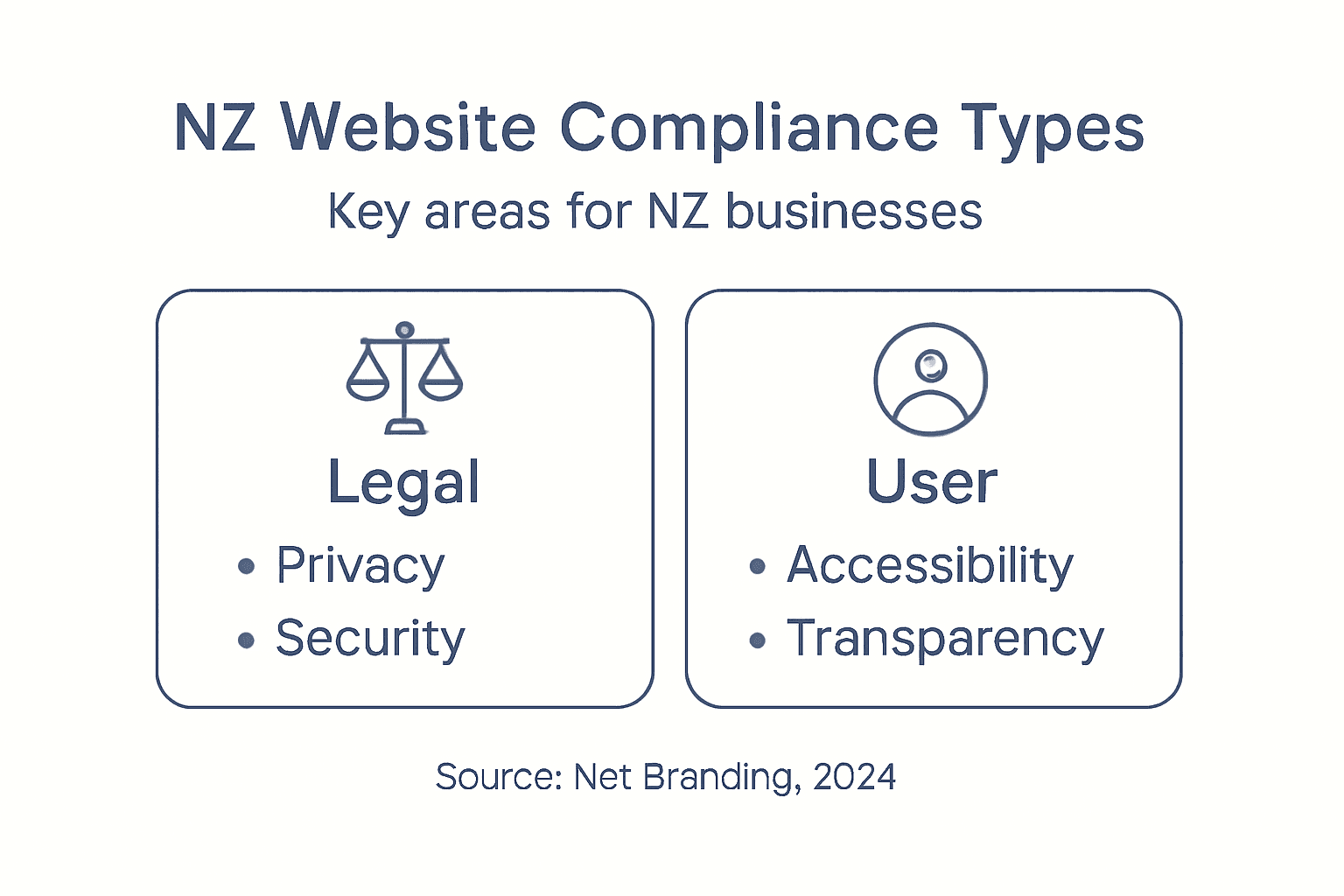
Website compliance encompasses several strategic categories essential for modern digital operations. These include user privacy protection, accessibility standards, transparency mechanisms, and robust security protocols. Each category addresses distinct legal and technical requirements that collectively ensure a comprehensive approach to digital responsibility.
The primary types of website compliance can be categorised as follows:
- Privacy Compliance
- Adherence to data protection regulations
- Implementing clear privacy policies
- Managing user consent mechanisms
- Protecting personal information
- Accessibility Compliance
- Ensuring websites are usable by people with disabilities
- Following Web Content Accessibility Guidelines (WCAG)
- Providing alternative text for images
- Creating keyboard-navigable interfaces
- Security Compliance
- Protecting against data breaches
- Implementing secure data transmission protocols
- Regular security audits
- Maintaining updated software and plugins
- Transparency Compliance
- Clear terms of service
- Honest business information
- Cookie consent notifications
- Transparent pricing and service details
Net Branding recommends that businesses approach compliance as an ongoing process rather than a one-time checklist. Regular reviews and updates are crucial to maintaining legal and ethical standards in an evolving digital environment.
Here’s a summary of how key website compliance categories protect both businesses and users:
| Compliance Category | Primary Focus | Business Benefit | User Protection |
|---|---|---|---|
| Privacy Compliance | Data handling & consent | Reduces liability, builds trust | Safeguards personal information |
| Accessibility | Inclusive website design | Expands customer base | Ensures equal access |
| Security | Protects against breaches | Minimises financial risk | Secures sensitive data |
| Transparency | Honest communication | Enhances reputation | Enables informed choices |
Pro tip: Conduct a comprehensive compliance audit annually and after any significant website changes to ensure continued adherence to current regulations.
FAQ
- How often should I review my website’s compliance?
- Annually or after major website updates
- What are the consequences of non-compliance?
- Financial penalties
- Potential legal action
- Reputational damage
- Do these compliance requirements apply to all websites?
- Yes, regardless of business size or industry
Legal obligations for New Zealand websites
New Zealand businesses operating online must navigate a complex landscape of legal requirements that protect both consumers and digital enterprises. Understanding these legal obligations is crucial for maintaining a compliant and trustworthy online presence that meets national regulatory standards.

New Zealand legislation mandates specific website compliance requirements encompassing multiple critical areas of digital operation. The primary legal frameworks businesses must consider include the Privacy Act, Fair Trading Act, and Electronic Transactions Act. These regulations establish comprehensive guidelines for data handling, consumer protection, information transparency, and digital transaction integrity.
Key legal obligations for New Zealand websites include:
- Privacy Protection
- Implementing robust privacy policies
- Obtaining explicit user consent for data collection
- Protecting personal information
- Allowing users to access and request data deletion
- Consumer Protection
- Providing clear and accurate business information
- Transparent pricing and service details
- Honest marketing representations
- Accessible contact information
- Digital Transaction Compliance
- Ensuring secure electronic transactions
- Maintaining transaction records
- Protecting financial information
- Following electronic communication standards
- Accessibility Requirements
- Supporting users with disabilities
- Providing alternative content formats
- Ensuring website navigation compatibility
- Meeting Web Content Accessibility Guidelines
Net Branding recommends businesses stay proactively informed about evolving digital regulations. Regular legal consultations and compliance audits can help organisations maintain up-to-date website practices that meet New Zealand’s stringent legal requirements.
Below is a comparison of major legal frameworks shaping NZ website compliance:
| Legislation | Purpose | Typical Application | Enforcement Risk |
|---|---|---|---|
| Privacy Act | Protecting user data | Privacy policy, consent forms | High for data breaches |
| Fair Trading Act | Honest consumer interactions | Clear pricing, fair claims | Moderate for misrepresentation |
| Electronic Transactions Act | Secure online dealings | E-commerce functionality | High for financial errors |
Pro tip: Consult with a legal professional specialising in digital regulations to conduct a comprehensive website compliance review annually.
FAQ
- What are the most significant legal risks for non-compliant websites?
- Financial penalties
- Potential legal action
- Reputational damage
- How frequently should websites update their legal documentation?
- Annually or when significant regulatory changes occur
- Are these requirements mandatory for all websites?
- Yes, regardless of business size or industry
Core compliance requirements for WordPress sites
WordPress websites require a comprehensive approach to digital compliance that goes beyond basic technical configuration. Business owners must understand the intricate legal and technical requirements that ensure their online presence remains secure, transparent, and legally sound.
WordPress hosting compliance involves multiple critical standards that protect both website owners and their users. These requirements encompass technical infrastructure, data privacy protocols, security measures, and user protection mechanisms that are essential for maintaining a professional and legally compliant digital platform.
Core compliance requirements for WordPress sites include:
- Technical Infrastructure
- Maintaining updated WordPress core version
- Using compatible PHP versions
- Ensuring HTTPS encryption
- Implementing secure hosting environments
- Data Privacy Compliance
- Creating comprehensive privacy policies
- Implementing cookie consent mechanisms
- Managing user data collection practices
- Providing transparent data usage information
- Security Protocols
- Regular security plugin updates
- Implementing robust user authentication
- Protecting against potential vulnerabilities
- Conducting periodic security audits
- User Rights Management
- Enabling user data access requests
- Supporting data deletion mechanisms
- Providing clear consent options
- Maintaining user information transparency
Net Branding recommends businesses approach WordPress compliance as an ongoing process. Regular reviews, updates, and proactive monitoring are crucial to maintaining a legally sound and secure digital presence.
Pro tip: Schedule quarterly compliance reviews and maintain a detailed documentation trail of your website’s privacy and security configurations.
FAQ
- How often should WordPress sites update for compliance?
- Quarterly or immediately when critical updates are released
- What are the main compliance risks for WordPress sites?
- Data privacy violations
- Security vulnerabilities
- Potential legal penalties
- Do these requirements apply to all WordPress websites?
- Yes, regardless of business size or industry
Risks of non-compliance and common mistakes
Website non-compliance represents a significant threat to businesses, potentially exposing them to substantial financial, legal, and reputational risks. Understanding these potential consequences is crucial for organisations seeking to protect their digital assets and maintain customer trust.
Failure to comply with regulations leads to significant organisational risks that extend far beyond simple administrative penalties. These risks can fundamentally undermine a business’s operational stability, financial health, and public perception.
Key risks and common compliance mistakes include:
- Financial Consequences
- Substantial regulatory fines
- Potential legal settlement costs
- Loss of business contracts
- Increased insurance premiums
- Legal Vulnerabilities
- Potential lawsuits from affected parties
- Government enforcement actions
- Mandatory compliance audits
- Risk of business license suspension
- Reputational Damage
- Erosion of customer trust
- Negative public perception
- Reduced market credibility
- Potential social media backlash
- Operational Disruptions
- Mandatory system redesigns
- Unexpected compliance remediation costs
- Potential temporary business interruptions
- Extended legal resolution processes
Common compliance mistakes often stem from neglecting regular reviews, outdated documentation, inadequate staff training, and insufficient understanding of evolving regulatory landscapes. Net Branding emphasises that compliance is an ongoing process requiring consistent attention and proactive management.
Pro tip: Develop a comprehensive compliance tracking system that includes automated alerts for regulatory changes and scheduled internal compliance reviews.
FAQ
- What are the most expensive non-compliance risks?
- Regulatory fines
- Legal settlements
- Reputational reconstruction costs
- How quickly can non-compliance impact a business?
- Immediately upon discovery of violations
- Potential instant legal proceedings
- Can small businesses be significantly affected?
- Yes, often more severely than larger organisations
Ensure Your Website Compliance Is a Strength, Not a Risk
Navigating the complexities of website compliance is a challenge many New Zealand businesses face. From privacy policies to accessibility standards and security protocols, meeting these legal obligations is crucial to protect your brand and build lasting customer trust. At ResponsiveWebsiteDesign, we understand these pain points and specialise in creating WordPress websites that not only look great but are fully compliant and optimised for your business goals.
Explore our expert solutions in the Website Archives where compliance and performance go hand in hand. Don’t leave your website exposed to legal risks or reputational damage. Partner with us to design, develop, and maintain a secure, accessible, and legally compliant digital presence. Visit ResponsiveWebsiteDesign today and take the first step towards peace of mind and online success.
Frequently Asked Questions
What is website compliance?
Website compliance refers to adhering to legal and regulatory standards that govern digital operations, ensuring businesses protect both their interests and their customers’ rights.
Why is website compliance important for New Zealand businesses?
Compliance helps build customer trust, avoids potential legal issues, and protects against financial penalties, which can significantly impact a business’s reputation and operations.
What are the main areas of website compliance that businesses need to focus on?
Key areas include privacy policies, cookie consent, accessibility standards, transparent business information, and secure data handling practices.
How frequently should businesses review their website compliance?
It is recommended to conduct compliance reviews annually or after any significant changes to the website to ensure it meets current legal standards.
Recommended
- Why Secure Your Website – Protecting NZ Businesses Online – ResponsiveWebsiteDesign
- Top Small Business Website Solutions in New Zealand: Our Top Picks – ResponsiveWebsiteDesign
- Top Small Business Website Solutions in New Zealand: Our Top Picks – ResponsiveWebsiteDesign
- How to Start a Company Website: A Step-by-Step Guide – ResponsiveWebsiteDesign
- Understanding the Purpose of Customizable Branding – Blog