
Over 94 percent of Australian and New Zealand online consumers admit that a confusing website makes them leave before buying. For small to medium businesses, every frustrated visitor is a lost sale or opportunity. Effective web usability shapes how easily people find products, navigate information, and complete purchases. This article explains the principles and testing methods behind smart usability, giving local owners practical steps to increase customer satisfaction and conversion rates.
Table of Contents
- Defining Web Usability For Businesses
- Key Principles That Influence Usability
- Types Of Web Usability Issues
- Testing Methods For Optimal Usability
- Common Mistakes And How To Avoid Them
Key Takeaways
| Point | Details |
|---|---|
| Importance of Web Usability | Web usability is essential for engaging online visitors and enhancing sales by ensuring intuitive user interactions. |
| Tailored Strategies | Each business should adopt a customised approach to web usability that aligns with its unique audience and digital goals. |
| Continuous Improvement | Regular user testing and analytics are vital for identifying usability issues and refining the user experience. |
| Common Usability Challenges | Addressing slow loading speeds, complex navigation, and poor mobile responsiveness can significantly improve customer engagement. |
Defining Web Usability for Businesses
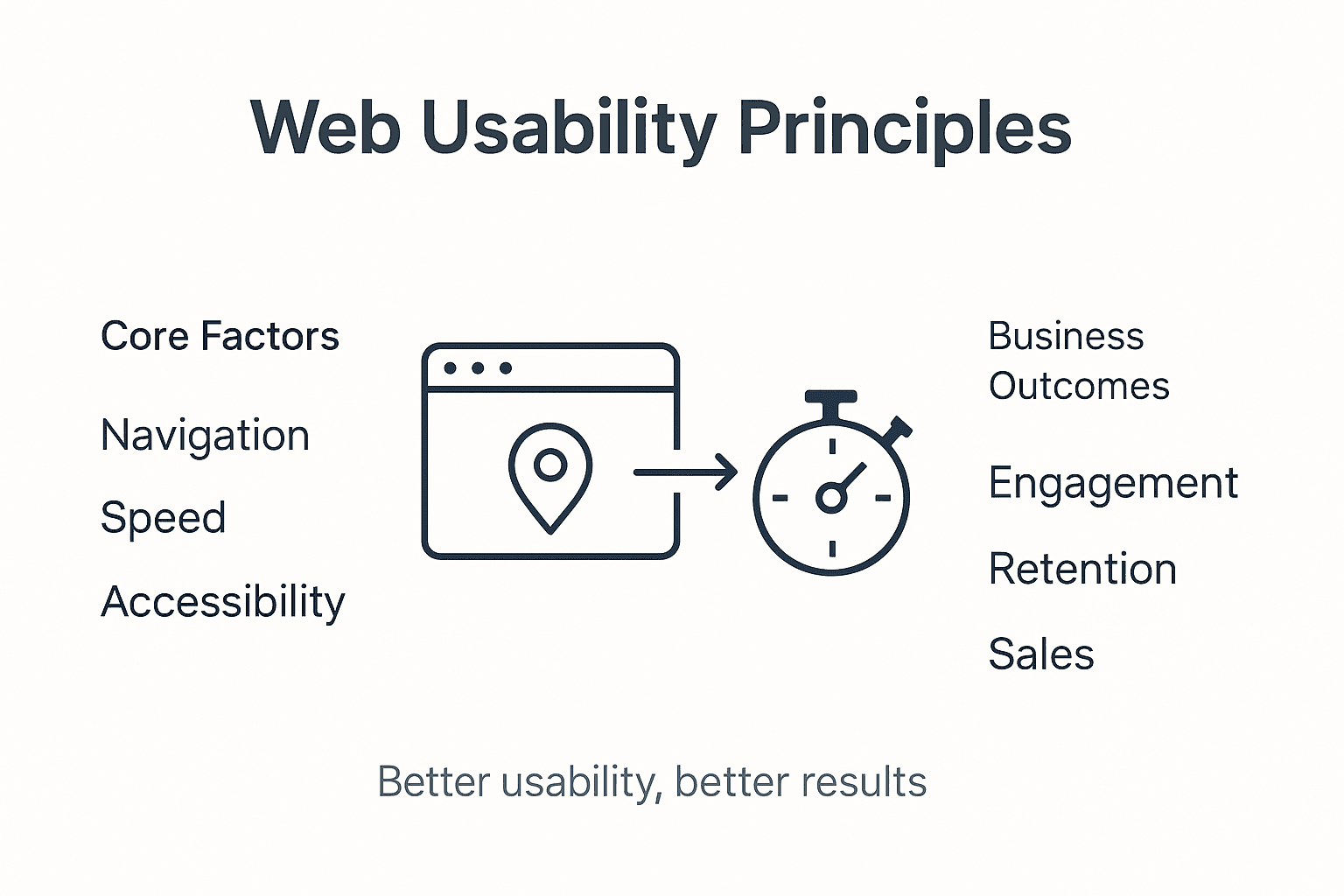
Web usability represents a critical digital strategy that determines how effectively businesses can engage online visitors and convert potential customers. At its core, web usability measures how intuitively users can interact with a website, navigating through content and completing desired actions with minimal friction. Understanding this concept goes beyond aesthetic design – it’s about creating meaningful, accessible digital experiences that align with user expectations and business objectives.
In the digital landscape of New Zealand, web usability directly impacts customer engagement and sales performance. Web accessibility and user experience are fundamentally interconnected, requiring businesses to consider diverse user needs, technical capabilities, and interaction preferences. This means designing websites that function seamlessly across different devices, load quickly, present clear navigation pathways, and provide intuitive interaction mechanisms.
Key components of effective web usability include:
- Clear and consistent site navigation
- Responsive design across mobile and desktop platforms
- Fast page loading times
- Readable typography and colour contrast
- Logical information architecture
- Minimal required user steps to complete actions
Net Branding recognises that web usability is not a one-size-fits-all approach. Each business requires a tailored strategy that reflects its unique audience, industry requirements, and specific digital goals. By prioritising user-centric design principles, companies can transform their websites from mere online brochures into powerful engagement and sales platforms.
Expert Tip: Conduct regular user testing and analyse website analytics to continuously refine and improve your website’s usability and user experience.
Key Principles That Influence Usability
Web usability transcends simple design aesthetics, representing a comprehensive approach to creating digital experiences that genuinely connect with users. Effective usability principles focus on ensuring users can seamlessly interact with digital platforms, considering diverse user needs and interaction capabilities across different technological contexts.

The fundamental principles influencing web usability can be categorised into several critical dimensions. Perceivability ensures that website information is presented in ways users can comprehend, which means designing with clear typography, appropriate colour contrast, and logical content organisation. Operability involves creating interfaces that users can navigate intuitively, minimising cognitive load and reducing potential frustration points during interaction.
Key usability principles include:
- Consistent and predictable navigation structures
- Intuitive interface design
- Rapid page loading performance
- Responsive design across multiple devices
- Clear communication of website functionality
- Accessibility for users with diverse abilities
Net Branding understands that usability is not a static concept but a dynamic process of continuous refinement. Businesses must adopt a user-centric approach, regularly testing and adapting their digital platforms to meet evolving user expectations and technological landscapes. By prioritising these principles, organisations can transform their websites from mere digital placeholders into powerful engagement tools that drive meaningful user interactions and business outcomes.
Expert Tip: Implement regular user testing sessions and analyse website interaction metrics to identify and address potential usability challenges proactively.
Types of Web Usability Issues
Web usability challenges can significantly undermine a business’s online effectiveness, creating barriers that prevent potential customers from engaging with digital platforms. Common web usability issues emerge across multiple dimensions, directly impacting user experience and conversion potential, affecting how visitors interact with and perceive an organisation’s digital presence.
Navigation complexity represents a primary usability obstacle for many websites. Users become frustrated when confronting confusing menu structures, unclear pathways, or inconsistent design elements that obstruct their ability to find desired information quickly. This complexity extends beyond visual design, encompassing information architecture that determines how content is organised, structured, and presented to visitors.
Key web usability issues include:
- Slow page loading speeds
- Non-responsive mobile design
- Unclear or cluttered navigation menus
- Insufficient colour contrast
- Inconsistent design across website pages
- Complex forms with multiple unnecessary fields
- Lack of clear call-to-action buttons
- Poor accessibility for users with disabilities
Net Branding recognises that addressing these usability challenges requires a holistic approach. Businesses must view their website as a dynamic communication tool, continuously refining user interactions to create seamless, intuitive digital experiences. By systematically identifying and resolving usability issues, organisations can transform potential friction points into opportunities for enhanced customer engagement and improved online performance.
The table below summarises how common web usability issues can impact business outcomes:
| Usability Issue | User Experience Effect | Potential Business Impact |
|---|---|---|
| Slow loading speeds | Causes user frustration, high bounce | Loss of conversions and sales |
| Complex navigation | Users struggle to find information | Reduced engagement and page views |
| Poor mobile responsiveness | Difficult browsing on mobile devices | Excludes mobile users, lowers reach |
| Inaccessible design | Blocks users with disabilities | Legal risks and reputational damage |
Expert Tip: Conduct comprehensive user testing and utilise heatmap analytics to systematically identify and prioritise website usability improvements.
Testing Methods for Optimal Usability
Web usability testing represents a strategic approach to understanding and improving digital user experiences. Comprehensive testing methods offer businesses critical insights into how users interact with their digital platforms, enabling targeted improvements that directly impact engagement and conversion rates.
Multiple testing methodologies provide nuanced perspectives on user interactions. Controlled laboratory testing allows for detailed observation of user behaviours, while remote testing enables businesses to gather insights from diverse geographical locations. A/B testing emerges as a powerful technique for comparing different design variations, helping organisations make data-driven decisions about website elements that most effectively support user goals.
Key usability testing approaches include:
- Heuristic evaluation by expert reviewers
- User task completion analysis
- Remote unmoderated testing
- Moderated in-person testing sessions
- Click tracking and heatmap analysis
- Prototype and wireframe testing
- Accessibility compliance testing
- User satisfaction surveys
Net Branding recognises that effective usability testing is an iterative process. Businesses must view testing not as a one-time activity but as a continuous cycle of observation, analysis, and refinement. By systematically collecting and implementing user feedback, organisations can create digital experiences that are not just functional, but truly engaging and intuitive.
Here’s a comparison of key usability testing methods and when to use them:
| Testing Method | Best For | Typical Outcome |
|---|---|---|
| Heuristic evaluation | Quick expert review of new designs | Identifies obvious usability flaws |
| Remote user testing | Gathering feedback from widespread users | Diverse perspectives, wide coverage |
| A/B testing | Comparing specific website elements | Data on user preferences |
| Heatmap analysis | Analysing areas of user attention | Reveals popular & ignored features |
Expert Tip: Rotate testing participants and methodologies to ensure comprehensive insights and prevent potential bias in your usability assessment.
Common Mistakes and How to Avoid Them
Web usability challenges often emerge from fundamental design misconceptions that create barriers between businesses and their potential customers. Recognising and addressing typical usability pitfalls requires a systematic approach to understanding user interaction dynamics, focusing on creating intuitive, accessible digital experiences.
One primary mistake businesses frequently make involves designing websites from an internal perspective rather than considering user needs and expectations. This approach leads to complex navigation structures, overcrowded interfaces, and content that fails to communicate effectively. Complex menus, excessive technical jargon, and inconsistent design elements can overwhelm visitors, causing them to abandon websites within seconds of arrival.
Common web usability mistakes include:
- Ignoring mobile responsiveness
- Overcomplicated navigation systems
- Slow page loading times
- Unclear or hidden call-to-action buttons
- Insufficient colour contrast
- Lack of consistent design language
- Overwhelming users with too much information
- Neglecting accessibility requirements
Net Branding understands that effective web design transcends aesthetic considerations. Businesses must adopt a user-centric approach, continually testing and refining their digital platforms to create seamless, engaging experiences that anticipate and meet user expectations. By systematically addressing usability challenges, organisations can transform potential friction points into opportunities for meaningful customer engagement.
Expert Tip: Conduct quarterly user experience audits to proactively identify and resolve potential usability obstacles before they impact customer interactions.
Elevate Your Website Usability With Expert WordPress Solutions
Struggling with slow page loading speeds, complicated navigation or poor mobile responsiveness can significantly hinder your business growth. This article highlights how crucial it is to prioritise web usability to boost engagement and sales. If your website fails to connect intuitively with users or lacks seamless functionality across devices you may be missing out on valuable customers right now.
Take control of your online presence with tailored WordPress website design and development from ResponsiveWebsiteDesign. Specialising in creating responsive, SEO-optimised websites that enhance user experience and meet your business objectives across New Zealand, we deliver measurable results through:
- Custom WordPress development
- Ecommerce solutions with WooCommerce
- Ongoing website management and security
- Performance optimisation to eliminate slow loading
Ready to transform your site into a powerful engagement and sales platform Visit Website Archives – ResponsiveWebsiteDesign to explore real success stories and detailed insights or head straight to our landing page to start your journey. Don’t let usability issues hold you back—partner with experts who understand how to convert your digital challenges into business growth opportunities today.
Frequently Asked Questions
What is web usability and why is it important for businesses?
Web usability refers to how effectively users can interact with a website. It’s crucial for businesses as it influences user engagement, conversion rates, and overall customer satisfaction.
What are the key components of effective web usability?
Key components include clear site navigation, responsive design, fast loading times, readable typography, logical information architecture, and minimal steps for users to complete actions.
How can I identify web usability issues on my site?
You can identify usability issues through regular user testing, analytics analysis, heatmap tracking, and by soliciting user feedback to pinpoint areas of confusion or difficulty.
What are common mistakes to avoid when designing for web usability?
Common mistakes include ignoring mobile responsiveness, using complex navigation systems, having slow page loading times, unclear call-to-action buttons, and overwhelming users with too much information.
Recommended
- How to Improve User Experience for Business Websites – ResponsiveWebsiteDesign
- 7 Essential User Experience Tips for Business Websites – ResponsiveWebsiteDesign
- The Essential Guide to UX in Websites – ResponsiveWebsiteDesign
- User Experience Design Process for Business Websites – ResponsiveWebsiteDesign
- Why Optimise WooCommerce Sites for Business Success – WPCTO