
More than 80 percent of users admit they leave a website after just one bad experience. In today’s digital world, how your visitors feel about your site makes all the difference between earning their loyalty or losing them to competitors. Understanding what shapes user experience gives you the power to create web designs that not only look appealing but also help people reach their goals smoothly and confidently.
Table of Contents
- Defining User Experience In Web Design
- Types Of User Experience: Beyond Usability
- Core Principles Of Effective UX Design
- Real-World Benefits For Business Websites
- Common UX Mistakes And How To Avoid Them
Key Takeaways
| Point | Details |
|---|---|
| User Experience (UX) Essentials | UX encompasses the full spectrum of user interactions with digital platforms, emphasizing emotional responsiveness and task efficiency. |
| Core UX Principles | Effective UX design hinges on user-centered design, consistency, meaningful feedback, and deliberate simplicity to create intuitive experiences. |
| Business Impact | Strategic UX design directly correlates with improved engagement, higher conversion rates, and enhanced brand loyalty for businesses. |
| Common UX Mistakes | Avoid pitfalls such as overcomplicating navigation and neglecting mobile responsiveness by prioritizing genuine user needs through thorough research. |
Defining User Experience in Web Design
User experience (UX) represents the comprehensive journey a person undergoes while interacting with a digital platform, encompassing every emotional and functional touchpoint. Wikipedia defines UX as a multifaceted interaction that includes “users’ emotions, beliefs, preferences, perceptions, physical and psychological responses, behaviors, and accomplishments” occurring before, during, and after engaging with a digital product.
At its core, user experience goes beyond mere visual design. It’s a strategic approach focused on reducing friction between a user’s intentions and their ability to accomplish tasks efficiently. CSUN emphasizes that UX fundamentally aims to minimize barriers between a user and their desired outcome, creating seamless digital interactions that feel intuitive and responsive.
In web design, user experience translates into practical considerations such as:
- Intuitive navigation structures
- Fast page loading times
- Mobile responsiveness
- Clear, accessible information hierarchy
- Minimal cognitive load for users
For businesses like those seeking 7 essential user experience tips, understanding UX means recognizing that every digital interaction represents an opportunity to build trust, engagement, and long-term customer relationships. Effective UX design isn’t just about looking good—it’s about creating meaningful, frictionless experiences that make users feel understood and empowered.
Net Branding principles suggest that successful UX integrates technical functionality with human-centered design, ensuring websites not only work perfectly but also feel natural and enjoyable to use.
 The ultimate goal is transforming complex digital interactions into smooth, satisfying experiences that leave users feeling confident and supported.
Types of User Experience: Beyond Usability
User experience transcends traditional usability metrics, encompassing a rich spectrum of human interactions with digital platforms. ArXiv research reveals that UX involves complex motivational profiles that significantly impact how users engage with technology, extending far beyond simple functional assessments.
Traditionally, businesses viewed user experience through a narrow lens of task completion and interface efficiency. However, modern understanding recognizes UX as a multidimensional construct. ArXiv emphasizes that user experience involves intricate layers including:
- Emotional responses
- Psychological perceptions
- Personal beliefs
- Contextual preferences
- Behavioral patterns
These nuanced dimensions suggest that effective UX design requires deep empathy and understanding of human psychology. While technical functionality remains crucial, successful digital experiences now prioritize creating meaningful, emotionally resonant interactions that go beyond mere utility.
Net Branding principles highlight that truly exceptional user experiences integrate technical excellence with human-centered design. By understanding users’ underlying motivations and emotional landscapes, businesses can craft digital environments that feel intuitive, engaging, and personally relevant. What is Responsive Design becomes more than a technical specification—it transforms into a strategic approach for creating connections that genuinely matter to users.
Core Principles of Effective UX Design
Effective user experience design is a strategic approach that goes far beyond aesthetic considerations. WAC research highlights four fundamental core principles that form the foundation of exceptional UX: user-centered design, consistency, meaningful feedback, and deliberate simplicity.
Here’s a summary of the core UX design principles and their impact:
| Principle | Focus Area | Impact on User Experience |
|---|---|---|
| User-Centred Design | Understanding user needs | Intuitive personalised journeys |
| Consistency | Predictable interactions | Easier navigation reduced errors |
| Meaningful Feedback | Responsive interfaces | User confidence task completion |
| Deliberate Simplicity | Reduced complexity | Minimal cognitive load clarity |
Journals Research emphasizes that successful UX design centers on understanding and anticipating user needs. This means creating digital experiences that are intuitive, responsive, and aligned with user expectations. Key elements of this approach include:
- Prioritizing user goals and perspectives
- Reducing cognitive load
- Creating predictable interaction patterns
- Ensuring accessibility across devices
- Minimizing unnecessary complexity
Technical execution matters immensely, but empathy drives truly remarkable user experiences. Designers must think beyond functionality to create emotional connections that make digital interactions feel natural and effortless. Net Branding principles suggest that great UX design transforms technical constraints into opportunities for meaningful engagement.
For businesses seeking to implement these principles, Responsive Design Tutorial provides practical insights into creating user-centric digital experiences. The ultimate goal is crafting interfaces that feel so intuitive that users barely notice the technology—they simply accomplish their objectives with ease and satisfaction.
Real-World Benefits for Business Websites
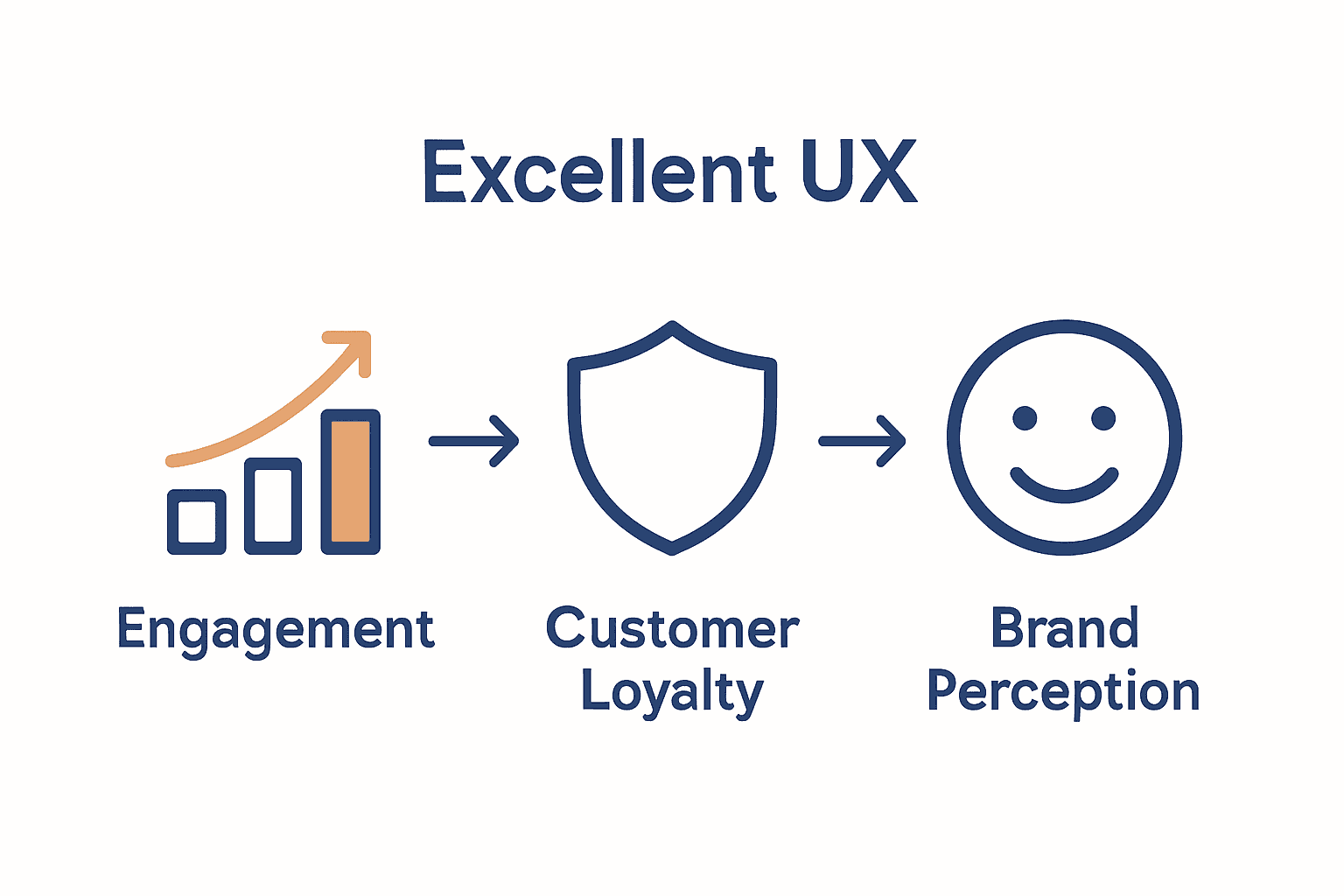
MR Research reveals a compelling truth about modern digital presence: user experience directly translates to business performance. Well-designed websites aren’t just digital brochures—they’re powerful conversion engines that can dramatically improve customer engagement, satisfaction, and ultimately, bottom-line results.
The tangible benefits of strategic UX design are substantial. Businesses can expect significant improvements through:
- Increased user engagement
- Higher conversion rates
- Improved customer retention
- Reduced customer support costs
- Enhanced brand perception
- Competitive differentiation
ArXiv highlights an fascinating dimension of UX design by demonstrating how emotional connection drives business performance. By integrating Kansei Engineering principles, companies can create websites that don’t just function—they resonate on an emotional level with users, transforming casual visitors into loyal customers.
Net Branding principles emphasize that modern websites must do more than look good—they must tell a compelling story. 7 Key Benefits of Responsive Websites provides deeper insights into how strategic design can become a genuine business asset. The most successful digital experiences are those that make users feel understood, valued, and effortlessly guided toward their goals.
Common UX Mistakes and How to Avoid Them
Wikipedia reveals a critical insight about UX design pitfalls: many businesses fall into the trap of creating what’s known as ‘The Elastic User’—a vague, shapeless concept that leads to ineffective design solutions. This happens when designers project their own preferences instead of understanding genuine user needs.
The most prevalent UX mistakes typically stem from a disconnection between design intent and user reality. Common missteps include:
- Overcomplicating navigation interfaces
- Ignoring mobile responsiveness
- Failing to provide clear user pathways
- Neglecting page loading speed
- Using confusing or inconsistent design elements
- Overlooking accessibility requirements
User Advocacy principles emphasize the importance of suspending personal biases to truly understand user perspectives. This means rigorous user research, creating detailed personas, and continuously testing design assumptions against real-world user behaviors.
Net Branding principles suggest that avoiding UX mistakes requires a holistic approach. Why Invest in Web Design provides deeper insights into creating user-centric digital experiences. The key is approaching design as an ongoing dialogue with users—constantly listening, adapting, and refining to ensure your digital platform genuinely serves their needs.
Elevate Your Business with User Experience That Truly Connects
Understanding the full scope of user experience is essential for any business wanting to engage customers effectively and build lasting relationships. This article highlights common challenges like confusing navigation, slow loading, and lack of emotional engagement — issues that can turn visitors away before you get a chance to show them what you offer. It also underlines key concepts such as user-centred design, consistency, and meaningful feedback, which are crucial for creating digital experiences that feel intuitive and trustworthy.
Is your business website falling short on these vital user experience principles? Now is the perfect time to partner with a team that specialises in crafting responsive, SEO-optimised WordPress websites designed with your users in mind. At Responsive Website Design, we deliver tailored solutions that not only look great but also reduce friction and increase customer engagement. From custom WordPress development to ongoing management and performance optimisation, we help New Zealand businesses turn every digital interaction into an opportunity for growth. Discover how our expertise can transform your online presence by visiting our website redesign services today and start your journey towards a website that truly works for your users and business goals.
Frequently Asked Questions
What is user experience (UX) in web design?
User experience (UX) in web design refers to the complete journey a user takes while interacting with a website, focusing on how users feel and their ability to perform tasks easily and efficiently.
Why is user experience important for businesses?
User experience is crucial for businesses as it can lead to increased user engagement, higher conversion rates, improved customer retention, and a stronger brand perception, ultimately impacting the bottom line.
What are some common mistakes to avoid in UX design?
Common mistakes in UX design include overcomplicating navigation, ignoring mobile responsiveness, failing to provide clear user pathways, neglecting page loading speed, and overlooking accessibility requirements.
How can businesses improve their user experience?
Businesses can improve their user experience by focusing on user-centered design, ensuring consistency, offering meaningful feedback, simplifying interactions, and conducting regular user testing to understand user needs better.
Recommended
- 7 Essential User Experience Tips for Business Websites – ResponsiveWebsiteDesign
- Blog – ResponsiveWebsiteDesign
- What Is Responsive Design? Complete Guide Explained – ResponsiveWebsiteDesign
- What Is Responsive Design? Complete Guide Explained – ResponsiveWebsiteDesign
- Comprendre l’expérience utilisateur web pour optimiser vos conversions