
Most Australian and New Zealand business websites lose visitors because their navigation and layout confuse users within seconds. For small and medium-sized company owners, poor wireframing can mean missed sales and wasted marketing spend. Learning how wireframing shapes your WordPress site’s journey is the first step to creating a site that keeps people engaged and climbs search rankings. Discover practical strategies for stronger user experience and smarter SEO.
Table of Contents
- Website Wireframing And Its Core Purpose
- Why Businesses Need Wireframing
- Frequently Asked Questions
- Key Types Of Wireframes Explained
- Practical Considerations For Wireframe Selection
- Essential Elements Of Effective Wireframes
- Practical Wireframing Strategies
- Improving User Experience And SEO With Wireframing
- Common Wireframing Mistakes And How To Avoid Them
Key Takeaways
| Point | Details |
|---|---|
| Importance of Wireframing | Wireframing is essential for translating concepts into structured designs, facilitating better communication and collaboration among stakeholders. |
| Types of Wireframes | Different wireframe types (low, mid, high fidelity) serve distinct purposes and stages in the design process, impacting both cost and efficiency. |
| User-Centric Focus | Effective wireframing prioritises user experience and interaction pathways, leading to more intuitive digital solutions. |
| Avoiding Common Mistakes | Key pitfalls include over-detailing designs and neglecting stakeholder collaboration, both of which can hinder successful outcomes. |
Website wireframing and its core purpose
Website wireframing represents a fundamental strategic approach in digital design that transforms abstract concepts into structured visual blueprints. This process creates a skeletal outline of a website, mapping out critical elements like navigation, content placement, and user interaction zones before investing substantial resources into detailed design and development.
At its core, wireframing serves multiple critical purposes for businesses seeking to create effective digital experiences. Website wireframing fundamentals involve creating simplified visual representations that communicate structural intentions without getting bogged down in aesthetic details. By focusing on functionality and layout, designers can collaborate more effectively with developers and stakeholders, ensuring everyone understands the proposed website architecture.
The primary objectives of wireframing include:
- Establishing clear content hierarchy
- Defining site navigation pathways
- Identifying potential user interaction points
- Facilitating early feedback and iterations
- Reducing potential costly redesign expenses
Net Branding recognises that successful wireframing goes beyond simple sketching. It requires strategic thinking about user experience, understanding client objectives, and creating intuitive digital interfaces that guide visitors seamlessly through information and conversion paths. By mapping out these interactions early, businesses can create websites that are not just visually appealing but fundamentally user-centric.
Pro tip: Conduct multiple rounds of wireframe reviews with stakeholders and potential end-users to validate navigation flow and identify potential usability challenges before full design implementation.
Why Businesses Need Wireframing
For New Zealand businesses navigating the competitive digital landscape, wireframing offers a critical advantage. It provides a cost-effective method to visualise and test website concepts without significant upfront investment. By creating low-fidelity representations, companies can quickly assess structural effectiveness, user journey potential, and alignment with business goals.

Wireframes act as a communication bridge between design teams, developers, and clients. They translate abstract ideas into tangible visual frameworks, allowing all stakeholders to provide meaningful input during early development stages. This collaborative approach minimises misunderstandings and reduces the likelihood of extensive revisions later in the design process.
Customer Review:
“Working with Net Branding’s wireframing process was incredibly insightful. They helped us understand our website’s potential user experience before we invested significant resources.” – Sarah Thompson, Local Auckland Business Owner
Frequently Asked Questions
How long does a typical wireframing process take?
Typically 1-2 weeks, depending on website complexity and stakeholder feedback cycles.Do wireframes include colour and design elements?
No, wireframes focus purely on structural layout and functionality, without aesthetic details.Can wireframes be created for mobile and desktop simultaneously?
Yes, responsive wireframing allows designers to plan layouts across multiple device types simultaneously.
Key types of wireframes explained
Wireframe design encompasses a spectrum of visual representation techniques that help businesses and designers communicate website structure and functionality. Wireframing approaches vary significantly based on the level of detail and purpose within the design process, ranging from basic conceptual sketches to highly sophisticated interactive representations.
The primary categories of wireframes are distinguished by their fidelity level, each serving unique objectives in the digital design workflow:
- Low-Fidelity Wireframes
- Extremely basic visual representations
- Typically hand-drawn or created with simple digital tools
- Focus on fundamental layout and content positioning
- Quick to produce and modify
- Ideal for initial brainstorming and concept exploration
- Mid-Fidelity Wireframes
- More refined than low-fidelity sketches
- Include precise spacing and basic visual hierarchy
- Use grayscale elements and placeholder content
- Provide clearer understanding of page structure
- Facilitate more detailed stakeholder discussions
- High-Fidelity Wireframes
- Highly detailed and pixel-perfect representations
- Closely mimic final design aesthetics
- Include precise interactive elements
- Used for advanced user testing and stakeholder presentations
- Require significant time and design expertise
Net Branding understands that selecting the appropriate wireframe type depends on project complexity, stakeholder expectations, and development stage. Each wireframe category offers unique advantages in translating conceptual ideas into tangible digital experiences.
Here is a comparison of wireframe fidelity levels and their typical uses:
| Wireframe Fidelity Level | Typical Use Stage | Stakeholder Benefit | Time Investment |
|---|---|---|---|
| Low-Fidelity | Early concept validation | Fast feedback and flexibility | 1-2 hours per page |
| Mid-Fidelity | Structural refinement | Clarity for team alignment | 4-6 hours per page |
| High-Fidelity | Near-final sign-off/testing | Demonstrates full functionality | 8-12 hours per page |
Pro tip: Always start with low-fidelity wireframes and progressively increase detail, allowing for flexible iteration and cost-effective design refinement.
Practical Considerations for Wireframe Selection
Choosing the right wireframe type requires careful consideration of project goals, timeline, and available resources. Low-fidelity wireframes work brilliantly for initial concept validation, while high-fidelity versions become crucial during final design approval and user experience testing.
For New Zealand businesses, understanding these nuanced wireframing approaches can significantly streamline digital product development. By strategically selecting wireframe types, companies can reduce design iterations, improve stakeholder communication, and create more user-centric digital solutions.
Customer Review:
“Net Branding’s wireframing process helped us visualise our website’s potential before investing substantial resources. Their methodical approach saved us time and money.” – Michael Roberts, Wellington Entrepreneur
Frequently Asked Questions
How long does each wireframe type take to create?
Low-fidelity: 1-2 hours, Mid-fidelity: 4-6 hours, High-fidelity: 8-12 hours.Can wireframes be created for multiple device types?
Yes, responsive wireframing allows designers to plan layouts across desktop, tablet, and mobile platforms.Are wireframes only used for websites?
No, wireframes are equally valuable for mobile apps, software interfaces, and digital product design.
Essential elements of effective wireframes
Creating compelling wireframes requires strategic understanding of digital user experience design principles. Core wireframe elements establish crucial website foundations that transform abstract concepts into structured digital experiences. By carefully mapping user interaction zones, content hierarchies, and navigation pathways, designers can craft intuitive interfaces that guide visitors seamlessly through digital landscapes.
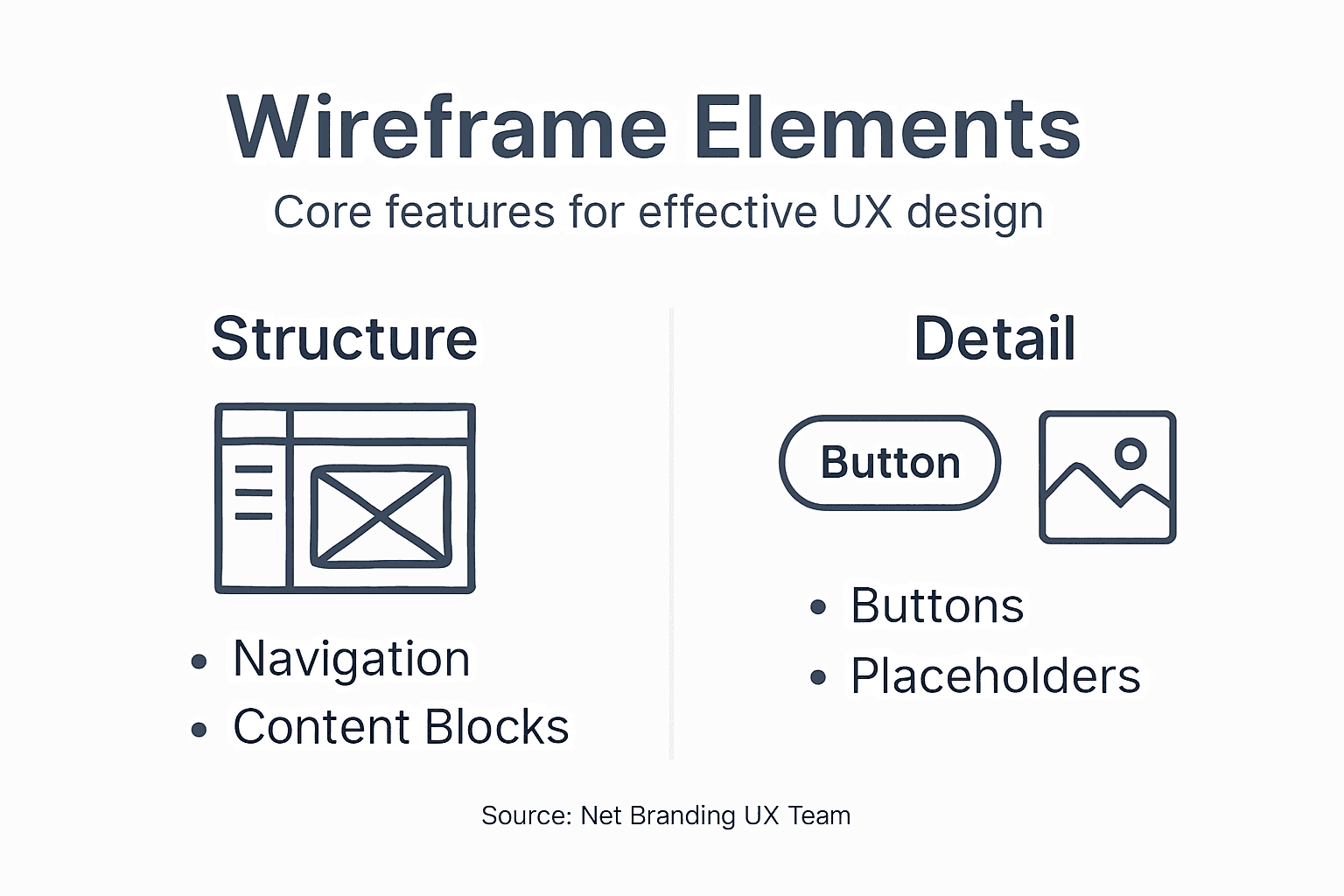
Critical Wireframe Components
Effective wireframes incorporate several fundamental elements that ensure optimal user engagement and functionality:
- Navigation Structures
- Clear menu placement
- Logical user pathways
- Intuitive hierarchical organisation
- Consistent navigation across pages
- Content Areas
- Defined content blocks
- Appropriate white space
- Balanced information distribution
- Strategic content prioritisation
- Interactive Elements
- Prominent call-to-action (CTA) buttons
- Form input zones
- Interactive component placements
- User engagement triggers
- Functional Zones
- Header and footer regions
- Search functionality spaces
- User account/login areas
- Responsive design considerations
Net Branding recognises that wireframing goes beyond simple sketching. It involves creating a strategic blueprint that communicates complex user experience requirements through minimalistic visual representations.
Pro tip: Use grayscale colour schemes and placeholder text to maintain focus on structural design rather than aesthetic details.
Practical Wireframing Strategies
Successful wireframe development demands a systematic approach that balances technical requirements with user-centric design principles. By focusing on functionality and user flow, designers can create digital experiences that feel natural and intuitive.
For New Zealand businesses, understanding these wireframing elements can transform digital projects from conceptual ideas to robust, user-friendly platforms. The key lies in maintaining simplicity while ensuring comprehensive functional coverage.
Customer Review:
“Net Branding’s wireframing process revealed user experience challenges we hadn’t previously considered. Their detailed approach saved us months of potential redesign work.” – Emma Thompson, Auckland Digital Entrepreneur
Frequently Asked Questions
How detailed should initial wireframes be?
Initial wireframes should focus on core functionality and user flow, avoiding aesthetic distractions.Can wireframes be created collaboratively?
Yes, modern design tools enable real-time collaborative wireframing across different locations.How often should wireframes be revised?
Wireframes should be iteratively refined throughout the design process, with major revisions after user testing and stakeholder feedback.
Improving user experience and SEO with wireframing
Wireframing serves as a strategic bridge between user experience design and search engine optimisation, offering businesses a powerful approach to digital interface development. Wireframing supports holistic website performance by creating structured pathways that enhance both user engagement and search engine visibility.
The intersection of user experience and SEO through wireframing involves several critical considerations:
- Content Hierarchy Optimization
- Logical information structure
- Strategic content placement
- Clear navigation paths
- Improved readability for users and search engines
- User Flow Engineering
- Intuitive site navigation
- Reduced user friction
- Minimal click paths
- Enhanced engagement metrics
- Search Engine Compatibility
- Clean, semantic HTML structures
- Mobile-responsive design considerations
- Fast-loading page frameworks
- Structured content zones
- Performance Indicators
- Lower bounce rates
- Extended user session duration
- Increased page views
- Improved organic search rankings
Net Branding recognises that effective wireframing transcends aesthetic design. It represents a strategic blueprint that communicates complex digital experiences while maintaining technical search engine requirements.
This table summarises how wireframing connects user experience and SEO improvements:
| Optimisation Focus | Wireframing Contribution | Business Outcome |
|---|---|---|
| Content Structure | Maps hierarchy for clarity | Guides visitors, boosts ranking |
| Mobile Responsiveness | Plans layouts for all devices | Improves SEO and engagement |
| User Flow Efficiency | Simplifies navigation pathways | Increases conversions |
| Clean Code Foundation | Supports semantic HTML planning | Enhances search visibility |
Pro tip: Create wireframes with mobile-first principles to ensure responsive design and optimal search engine performance across all devices.
Strategic UX and SEO Alignment
Successful wireframing demands a nuanced understanding of how user experience directly influences search engine performance. By prioritising user-centric design principles, businesses can create websites that not only look appealing but also perform exceptionally in search results.
For New Zealand businesses, mastering wireframing techniques means developing digital platforms that speak both to human users and search engine algorithms. The goal is creating seamless, intuitive experiences that naturally encourage longer engagement and improved visibility.
Customer Review:
“Net Branding’s wireframing approach transformed our digital strategy. Their method ensured our website was not just visually appealing, but strategically engineered for performance.” – James Williams, Wellington Digital Entrepreneur
Frequently Asked Questions
How quickly can wireframing impact SEO?
Initial improvements can be observed within 3-6 months of implementing strategic wireframe design.Do wireframes guarantee better search rankings?
Wireframes provide a strong foundation, but consistent content quality and technical optimization remain crucial.Can wireframing help mobile website performance?
Absolutely. Mobile-optimised wireframes are essential for improving search rankings and user experience.
Common wireframing mistakes and how to avoid them
Wireframing requires strategic precision to effectively translate digital design concepts into functional user experiences. Common wireframing pitfalls can significantly compromise project outcomes, making understanding and mitigating potential errors crucial for successful website development.
Key Wireframing Mistakes to Avoid
Designers and businesses frequently encounter several critical wireframing challenges:
- Over-Detailing Initial Designs
- Adding unnecessary aesthetic elements
- Distracting from core structural considerations
- Premature visual complexity
- Limiting design flexibility
- Neglecting User-Centric Perspectives
- Failing to consider actual user journeys
- Ignoring potential interaction points
- Designing without comprehensive user research
- Prioritising technical constraints over usability
- Insufficient Stakeholder Collaboration
- Limited cross-functional feedback
- Minimal client input during early stages
- Lack of iterative review processes
- Communication gaps between design teams
- Skipping Comprehensive Testing
- Avoiding user experience validation
- Not conducting multiple design iterations
- Neglecting performance metric analysis
- Limited prototype testing scenarios
Net Branding recognises that effective wireframing transcends technical execution. It demands a holistic understanding of user interaction, business objectives, and design principles.
Pro tip: Create multiple wireframe versions and conduct structured user testing to validate design effectiveness before finalising your approach.
Strategic Error Prevention
Successful wireframing requires continuous learning and adaptation. By anticipating potential mistakes and implementing robust design processes, businesses can develop more intuitive and engaging digital experiences.
For New Zealand businesses, mastering wireframing means understanding that each design iteration represents an opportunity to refine user interaction and solve complex digital challenges. The goal is creating seamless, user-friendly platforms that effectively communicate brand messaging.
Customer Review:
“Net Branding’s meticulous wireframing approach helped us identify and resolve potential usability issues before they became costly problems.” – Sarah Johnson, Auckland Digital Strategist
Frequently Asked Questions
How many wireframe iterations are recommended?
Typically 3-5 iterations, depending on project complexity and stakeholder feedback.Who should be involved in wireframing reviews?
Cross-functional teams including designers, developers, marketers, and potential end-users.How long does a comprehensive wireframing process take?
Usually 2-4 weeks, accounting for research, design, testing, and refinement stages.
Transform Your Website Vision Into Reality With Expert Wireframing and WordPress Solutions
The article highlights how crucial wireframing is for shaping a successful user experience by defining clear navigation, content hierarchy, and interaction points. If you are a New Zealand business struggling with translating your website ideas into functional, user-centric designs that improve engagement and SEO, this is where you need a reliable partner. Wireframing sets the foundation, but converting it into a responsive, optimised website requires deep development expertise and strategic planning.
Uncategorized Archives – ResponsiveWebsiteDesign offers a window into how professional wireframing can fit into comprehensive digital solutions.
Don’t let your website redesign or new project get stuck in costly iterations or lose visitors due to poor user flow. Take advantage of our tailored WordPress design and development services at ResponsiveWebsiteDesign to create intuitive, SEO-friendly websites that truly resonate with your audience. Start your journey today and experience how strategic wireframing paired with expert development can elevate your online presence to new heights.
Frequently Asked Questions
How long does a typical wireframing process take?
Typically 1-2 weeks, depending on website complexity and stakeholder feedback cycles.
Do wireframes include colour and design elements?
No, wireframes focus purely on structural layout and functionality, without aesthetic details.
Can wireframes be created for multiple device types?
Yes, responsive wireframing allows designers to plan layouts across desktop, tablet, and mobile platforms.
What are the advantages of low-fidelity wireframes?
Low-fidelity wireframes allow for quick production and modifications, making them ideal for initial brainstorming and concept exploration.
Recommended
- User Experience Design Process for Business Websites – ResponsiveWebsiteDesign
- Prototyping in Web Design: Boosting User Experience – ResponsiveWebsiteDesign
- What Is User Experience? Complete Business Guide – ResponsiveWebsiteDesign
- How to Improve User Experience for Business Websites – ResponsiveWebsiteDesign
- Understanding the Role of Visual Branding in Business – Blog